

Why We Feel Stuck: The Biology of the Battle
How many times today have you tried to explain the truth to a person living with dementia, only to end up more frustrated, more exhausted, and further from a connection? If you feel like you’re constantly running on a broken engine, it’s not because you aren’t trying hard enough—it’s because you’re playing by the wrong rules, and I’m going to share what’s going on.
Even if you don’t have a definitive diagnosis yet, but are pretty sure there’s some sort of dementia going on, now is the best time to plan ahead on how you’re going to navigate this unknown territory.
After years as a registered nurse, I know firsthand that caregiving isn’t just physically demanding. It’s especially mentally exhausting. Back then, we didn’t have a reliable way to navigate those tough, confusing moments. I know from experience that care aides often didn’t, either. We spent years trying to ‘fix’ situations that couldn’t be fixed, and it only led to burnout.
Today, I’m sharing a name and a structure for the approach I’ve learned to use over the years—an approach born from watching what didn’t work, and refining what did.
The Most Common Mistake We Make
Treating a person living with dementia as if they have the same cognitive processing power they used to is a logic trap we all fall into. When we rely on logic to ‘fix’ a situation, we’re actually asking a brain that has physically lost the capacity to do the impossible.
Here’s a common scenario where this happens — and why our natural, logical reaction tends to backfire:
The ‘What Year Is It?’ Struggle – Imagine your loved one insists they need to leave to pick up their children from school, even though those children are now grown adults.
Responding with, ‘Mom, you don’t have kids in school anymore, they are in their 40s! Don’t you remember?’ This forces them to confront a reality that no longer aligns with their brain’s internal map, triggering panic or defensiveness.
Recognizing this pattern is the hardest part, but I promise you, once you make the shift in the way you respond or react to the person living with dementia, and escalating stress for both of you, your days will improve. You’ll feel empowered, and the person living with dementia will no longer need to react in fear when faced with logic.
Flipping the Script: The Soft Landing Method
When we stop viewing communication as a test of “who is right,” we can finally start viewing it as a tool for connection. The Soft Landing Method isn’t about ignoring the truth; it’s about prioritizing the emotional safety of the person living with dementia over factual accuracy.
By leaning on the three pillars of Validation, Reassurance, and Redirection, we can pivot from a defensive stance to a supportive partnership.
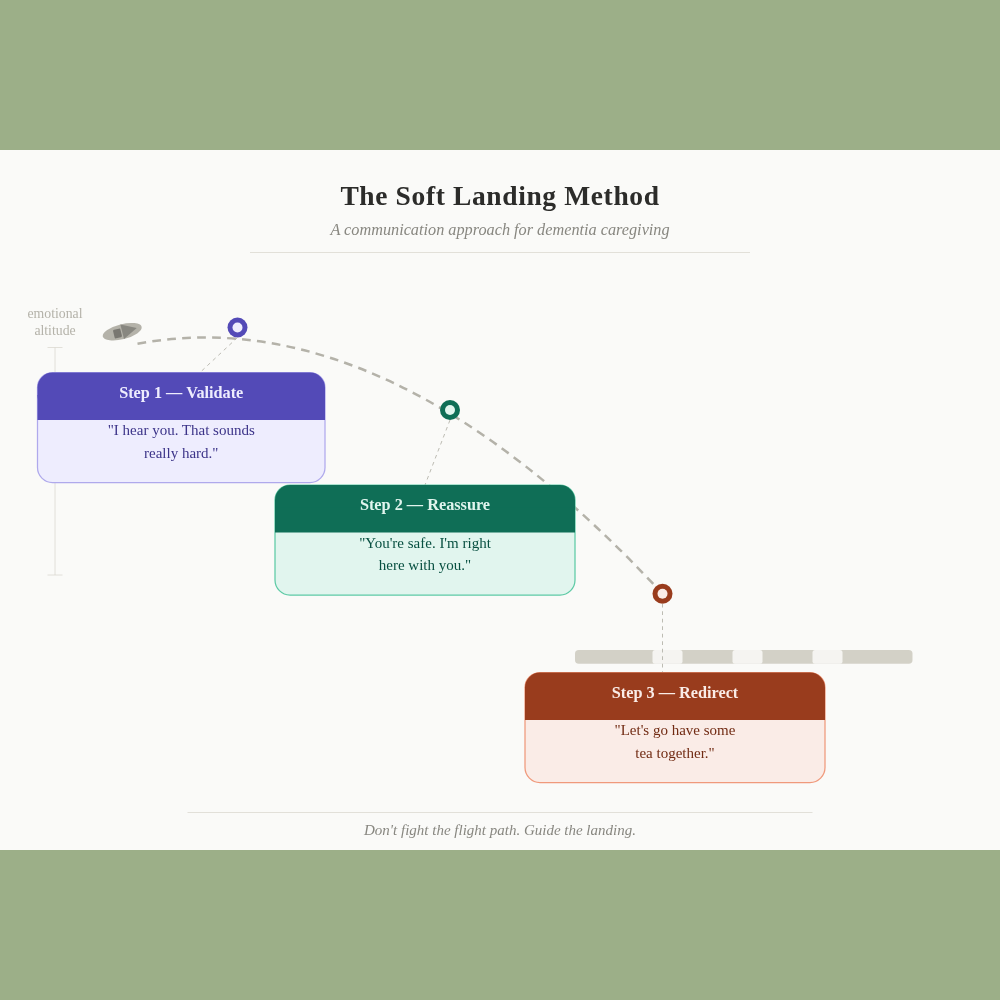
Validate: Acknowledge the core emotion the person living with dementia is feeling right now (fear, loneliness, confusion).
Reassure: Verbally and physically signal that the person living with dementia is completely safe and cared for.
Redirect: Gently pivot their physical attention toward a familiar, low-stress task or object.
Before you even attempt to Validate, Reassure, or Redirect, start with a simple, neutral bridge phrase. My favourite is: “I can see that’s weighing on you.” It’s low-pressure, immediately validates the emotion, and buys you a moment to decide which pillar to lean on next.
Let’s look again at that scenario using the Soft Landing Method.
The “What Year Is It?” Struggle — Instead of correcting, acknowledge the feeling behind the urgency: “You’re worried about them, aren’t you? You’re such a dedicated mom. Tell me more about what they were like when they were little.” You’ve moved from a debate about facts to a conversation about love.
Creating a Foundation for Success
A predictable, low-stimulation environment makes every one of these moments easier — think reduced background noise and a few familiar, tactile items kept within reach for easy redirection. (I walk through exactly how to set this up, room by room, inside the full guide.)
I often say the dementia journey is not for the person living with dementia, but more for those left behind, because that’s exactly what it is like. Those left behind have to pick up the pieces and learn to meet the person living with dementia where they are at, not try to convince them to understand and remember. Dementia progressively (meaning it gets worse) damages the frontal and temporal lobes, the parts of the brain where logic, time, and factual data get processed. When these areas stop working, we need to stop using logic, time, and factual data. It just cannot be processed.
When you try to reason with a person living with dementia, the damaged brain experiences this logic as a confusing, stressful threat, triggering a fight-or-flight response that spikes cortisol levels for both of you.
This example is one of nine scenarios I walk through in The Soft Landing Method Guide — including sundowning, medication refusal, repetitive questions, accusations, and the moments that don’t have easy answers yet. Each one comes with the exact script, why it works, and the Comfort Station template to make redirection effortless.
[Get the Soft Landing Method Guide →]
And if you’d like support like this delivered straight to your inbox, I share practical scripts and strategies twice a week in my newsletter. Sign up below.