
Stop Correcting. Start Connecting.
The Soft Landing Method Guide — nine real dementia caregiving moments, the exact words that make them easier, and the printable tools to make it stick.
You’ve tried explaining the truth, gently, again and again. You’ve tried reasoning, reminding, showing them the calendar, the photo, the proof. And somehow it still ends the same way — more distance, more distress, more of that quiet exhaustion that doesn’t show up on anyone’s radar but yours.
It’s not because you’re not trying hard enough. It’s because a dementia-affected brain can’t process logic, time, or facts the way it used to — so every “well actually” is a small confrontation it experiences as a threat.
There’s a different way to respond. I call it the Soft Landing Method, and it’s changed how thousands of hard moments go for the caregivers I’ve worked with.
“Sound Familiar?”
- They insist they need to pick up kids who are now grown adults
- They accuse you of stealing something that’s simply been misplaced
- They don’t recognize you, or call you by someone else’s name
- The sun starts going down and so does their sense of calm
- They ask the same question for the fifth time in twenty minutes
- Bath time turns into a battle neither of you wanted
If any of these landed a little too close, this guide was built for exactly that moment.
What’s Inside the Bundle?
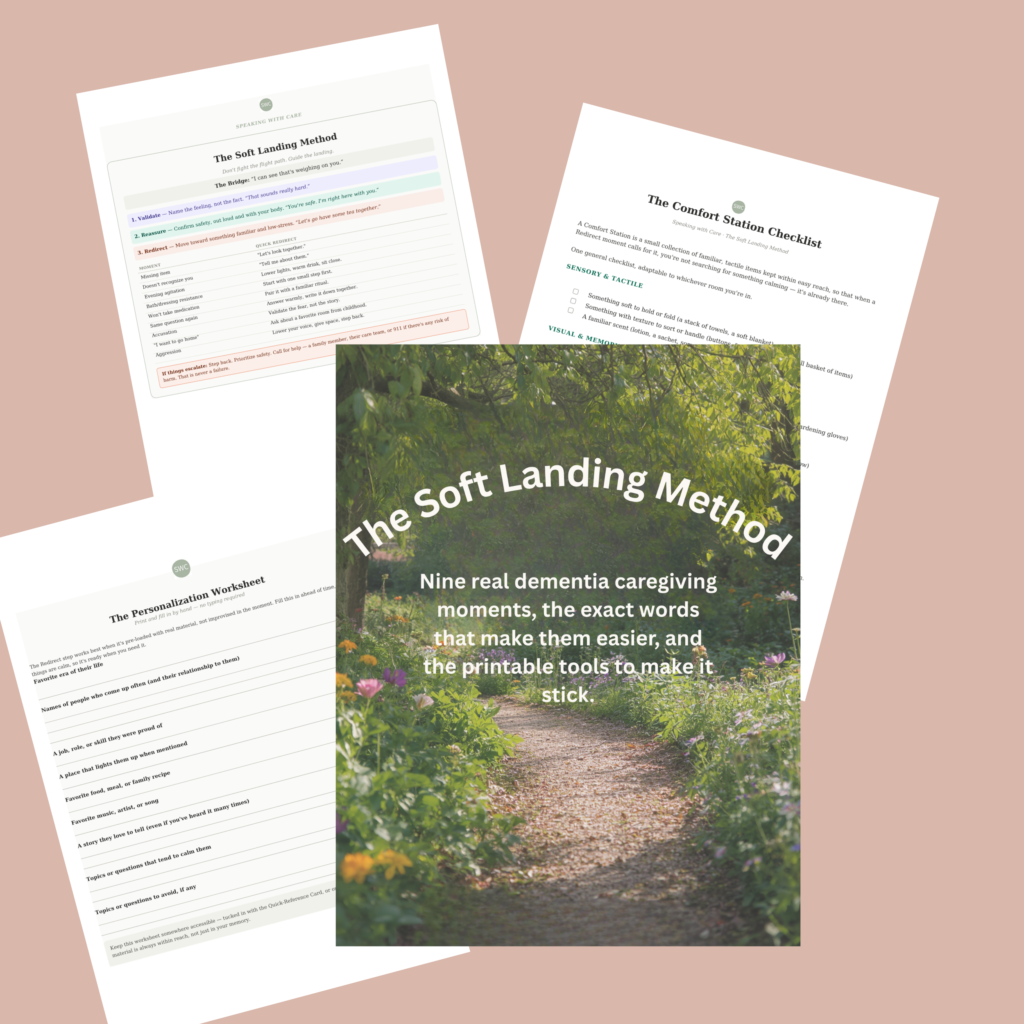
📘 The Soft Landing Method Guide (15-page PDF)
The full framework, plus a real, word-for-word script for all nine of the moments caregivers hit most:
- The Missing Item Frustration
- The “Wait, Who Are You?” Interaction
- Sundowning / The Evening Shift
- Bathing or Dressing Resistance
- Medication Refusal
- Repetitive Questions
- Accusations
- “I Want to Go Home”
- Aggression or Combativeness
Each one broken down the same way: what’s actually happening in their brain, why your natural instinct backfires, the exact Soft Landing script, and why it works.
🖇️ The Comfort Station Checklist (printable)
A ready-made list of the sensory, visual, and task-based items that make the Redirect step effortless — so you’re never scrambling for something calming in the moment.
📝 The Personalization Worksheet (printable)
Fill this in ahead of time, when things are calm, so your Redirect step is already loaded with the names, memories, and topics that work — instead of being improvised under stress.
🗂️ The Quick-Reference Card (printable)
The whole Method, condensed to a single page for the fridge, your bag, or your back pocket — for the days you don’t have time to think, only to act.
Why This Is Different
This isn’t generic advice to “be patient” or “stay calm.” It’s the specific language for the specific moments — tested, refined, and written by someone who has stood in that hallway at 4pm, out of ideas, more times than she can count.
Meet the Method
After years as a registered nurse, and then as a family caregiver myself, I built the Soft Landing Method out of watching what didn’t work — and refining what did.
Validate. Reassure. Redirect. Three steps that prioritize emotional safety over factual accuracy, so you stop fighting the flight path and start guiding the landing.
It’s not a script to memorize under pressure. It’s a way of thinking that, once it clicks, changes how the hardest five minutes of your day actually go.
$27 – Instant Download
One hard evening avoided is worth more than that. This bundle is designed to earn its place on your fridge, not your bookshelf.
GET THE SOFT LANDING METHOD GUIDE + 3 PRINTABLES
You don’t have to get every moment perfect. You just have to keep guiding the landing, one soft moment at a time.
xo Sue